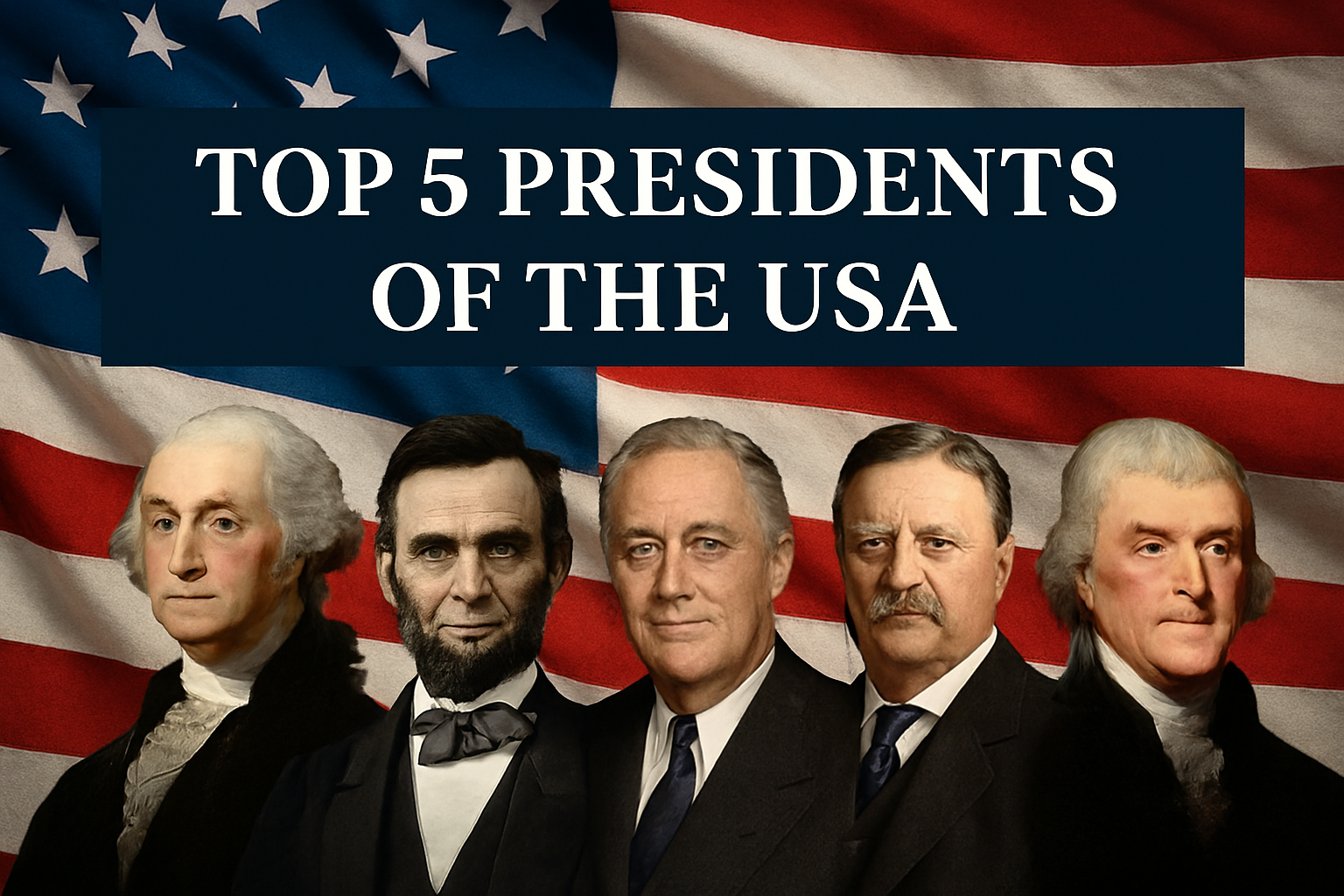
The presidency of the United States is one of the most powerful and scrutinized offices in the world. Each president has faced unique challenges, shaped national identity, and influenced global affairs. While opinions differ depending on political leanings, historians and scholars often converge on a handful of leaders whose vision, courage, and decisions left indelible marks on the nation.
This article explores the top five presidents of the USA—George Washington, Abraham Lincoln, Franklin D. Roosevelt, Theodore Roosevelt, and Thomas Jefferson—highlighting their achievements, leadership styles, and enduring legacies.
1. George Washington (1789–1797
Founding Father and First President
George Washington, the first president of the United States, is often revered as the “Father of His Country.” His leadership during the Revolutionary War and his steady hand in guiding the fledgling republic set precedents that continue to shape the presidency today.
Key Achievements
- Establishing Presidential Authority: Washington defined the role of the president, balancing executive power with republican ideals. He refused to be seen as a monarch, instead embodying humility and service.
- Neutrality in Foreign Affairs: His Neutrality Proclamation of 1793 kept the young nation out of European conflicts, allowing America to grow without external entanglements.
- Two-Term Precedent: By voluntarily stepping down after two terms, Washington set a democratic precedent later codified in the 22nd Amendment.
Legacy
Washington’s greatest legacy lies not in policy but in character and precedent. His restraint, integrity, and devotion to republican ideals ensured that the presidency would not devolve into tyranny. He remains a symbol of unity and civic virtue.
2. Abraham Lincoln (1861–1865)
The Great Emancipator
Abraham Lincoln’s presidency was defined by the Civil War, the nation’s gravest crisis. His leadership preserved the Union and redefined the meaning of freedom in America.
Key Achievements
- Preservation of the Union: Lincoln’s unwavering commitment to national unity guided the country through its bloodiest conflict.
- Emancipation Proclamation (1863): Though limited in immediate effect, it transformed the Civil War into a moral struggle against slavery and paved the way for the 13th Amendment.
- Gettysburg Address: In just 272 words, Lincoln articulated the nation’s democratic ideals, emphasizing equality and government “of the people, by the people, for the people.”
Legacy
Lincoln’s assassination cut short his vision for reconciliation, but his legacy endures as the president who saved the Union and abolished slavery. His humility, eloquence, and moral clarity make him a timeless figure in American history.
3. Franklin D. Roosevelt (1933–1945)
Architect of the New Deal
Franklin D. Roosevelt (FDR) led the nation through two of its greatest crises: the Great Depression and World War II. His unprecedented four-term presidency reshaped the role of government in American life.
Key Achievements
- The New Deal: A sweeping set of programs that provided relief, recovery, and reform during the Depression. Social Security, banking reforms, and public works projects transformed the economic landscape.
- World War II Leadership: FDR’s strategic vision and alliance-building helped defeat fascism. His “Arsenal of Democracy” speech and Lend-Lease program supported allies before U.S. entry into the war.
- Fireside Chats: Through radio broadcasts, Roosevelt reassured citizens, building trust and confidence in government during turbulent times.
Legacy
FDR expanded the scope of federal government, embedding social welfare and economic regulation into American life. His leadership during WWII positioned the U.S. as a global superpower. Despite controversies, his resilience and vision cement him as one of the most transformative presidents.
4. Theodore Roosevelt (1901–1909
The Progressive Reformer
Theodore Roosevelt, often called “TR,” brought energy, charisma, and reformist zeal to the presidency. He championed progressive policies, conservation, and America’s emergence as a global power.
Key Achievements
- Trust-Busting: Roosevelt aggressively pursued monopolies, earning the nickname “trust-buster.” His actions strengthened fair competition and curbed corporate abuses.
- Conservation Movement: He established national parks, forests, and wildlife refuges, protecting millions of acres of land. His conservation legacy remains foundational to environmental policy.
- Foreign Policy: Roosevelt’s “Big Stick” diplomacy expanded U.S. influence. The construction of the Panama Canal symbolized America’s growing global reach.
- Nobel Peace Prize: He brokered peace in the Russo-Japanese War, becoming the first American president to win the Nobel Peace Prize.
Legacy
TR’s presidency embodied progressivism, conservation, and assertive leadership. His reforms modernized government, while his conservation efforts safeguarded natural treasures for future generations.
5. Thomas Jefferson (1801–1809)
Author of Liberty
Thomas Jefferson, the principal author of the Declaration of Independence, brought intellectual depth and democratic ideals to the presidency. His vision of an agrarian republic shaped America’s early identity.
Key Achievements
- Louisiana Purchase (1803): Jefferson doubled the nation’s size, securing vast territory that fueled westward expansion.
- Lewis and Clark Expedition: He commissioned exploration of the new lands, advancing scientific knowledge and mapping routes for settlement.
- Democratic-Republican Ideals: Jefferson championed limited government, states’ rights, and individual liberty, influencing American political philosophy.
Legacy
Jefferson’s contradictions—espousing liberty while owning slaves—complicate his legacy. Yet his vision of democracy, expansion, and intellectual pursuit remains central to America’s identity.